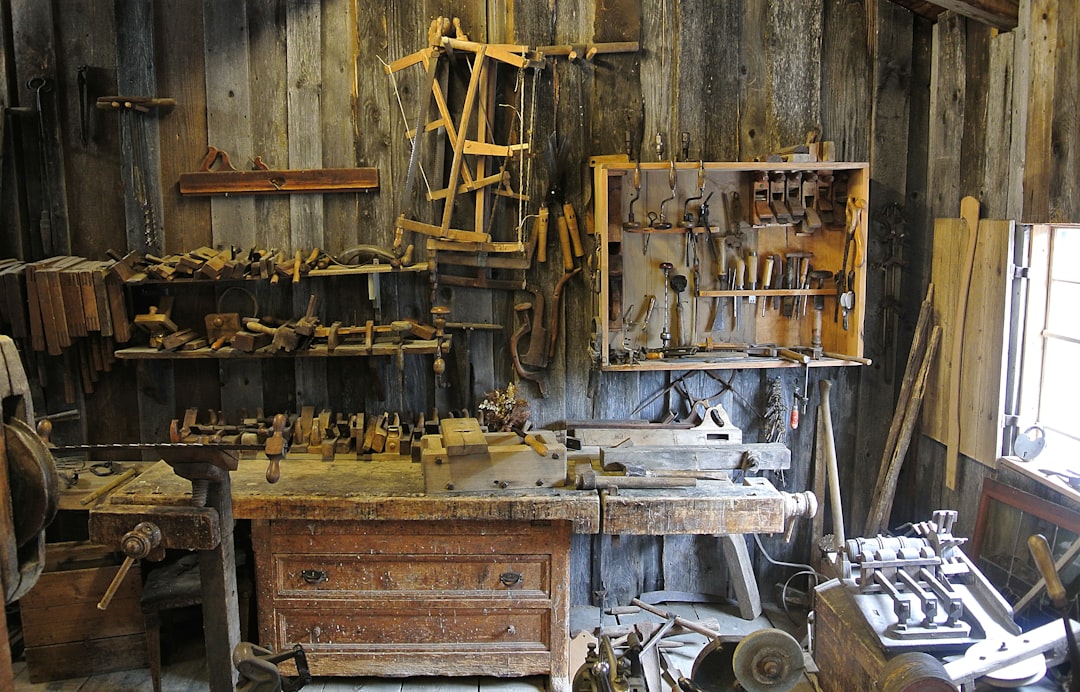
What Height Should a Woodworking Bench Be?
For most adults a woodworking bench should sit between 850mm and 900mm from the floor, which is roughly wrist height when you stand beside it with your arms hanging loose. That number is a starting point, not a rule, because the right height depends on your body and on the work you do most. Drop the surface to about 750mm for hand planing, and raise it to 950mm or more for joinery, carving and detail work. If you are buying rather than building, a dual-height folding bench such as the BLACK+DECKER Workmate 536 gives you two of those heights for around £50, while an adjustable bench with an 81cm to 106cm range lets you set the surface to your own measurement.
🔑 Key Takeaways
- Most adults want a bench top at 850mm to 900mm from the floor for general building, repair and assembly work.
- Hand planing and heavy sawing want a lower bench of around 750mm to 780mm so your body weight does the cutting.
- Joinery, carving and detail work want a higher surface of 950mm or more, because fine cuts need a short viewing distance.
- The quickest test is to stand with your arms relaxed and check where the bench meets your wrist and first thumb knuckle.
📚 Suggested Reading: Workbenches compared · How to build a simple workbench
The quick answer: your wrist sets the height
There is no official workbench height, because reach matters more than any standard. The wrist test gets most people close in less than a minute. Stand beside the bench with your arms hanging loose, then mark where the crease of your wrist falls. A surface at that height suits general building, assembly and repair work for most adults, which is why 850mm to 900mm covers so many home workshops.
Wood Magazine uses the same idea with a different landmark, putting the top at the height of your first thumb knuckle with your arms relaxed. Paul Sellers works through the same question and notes that benches as low as 30 inches suited earlier generations of hand tool work, while a modern hybrid workshop usually sits higher. The widely copied variation from bench builder Christopher Schwarz drops the measurement to the pinky knuckle, which lands a little lower again for planing work.
The elbow test comes second and matters more once you start clamping work down. Bend your arm to a right angle and the bench should sit level with, or slightly below, your elbow for general assembly. Set your vise so the tops of the jaws land at your relaxed elbow height, and sawing stops straining your shoulder.
Precision here is a matter of direction rather than millimetres. Taller makers sit at the top of every range and shorter makers sit at the bottom, so measure your own body instead of trusting a number from a forum post written by someone a foot taller than you.
Workbench height by task
Height is really a question of what you do most at the bench. The ranges below come from a mix of woodworking practice and ergonomics guidance, and all of them assume a healthy adult working standing up. A workshop that mixes several jobs usually needs one height chosen for the dominant task, plus a cheap way to change it for the rest.
| Task at the bench | Bench height | Why it works |
|---|---|---|
| Heavy hand planing and dimensioning | 700mm to 780mm (28in to 31in) | Your body weight drives the cut, so you need to be over the work rather than behind it. |
| Sawing timber held in a vise | 750mm to 800mm (29in to 31in) | A lower surface gives you a longer, flatter stroke with the saw plate level. |
| General woodworking and assembly | 850mm to 900mm (33in to 35in) | This lands at wrist height for most adults and suits mixed work. |
| Power tool work, routing and sanding | 900mm to 950mm (35in to 37in) | You need to watch the cutter, so the work sits closer to your eyes. |
| Joinery, carving and chisel work | 950mm to 1000mm (37in to 39in) | Fine cuts need a short viewing distance and a supported wrist. |
| Sharpening station | 950mm to 1050mm (37in to 41in) | A stone at or just below elbow height keeps your shoulders relaxed. |
| Seated work at a bench | 700mm to 750mm (28in to 30in) | Knee room and a relaxed forearm set the height rather than your height standing. |
Widely quoted guides for woodworking put the general band at 34 to 36 inches and the planing band at 28 to 32 inches, which matches the table above once you convert to metric. The English Woodworker makes a similar split, noting that tall workbenches suit joinery and power tool use while lower benches suit work where you push a tool through timber.
What the ergonomics guidance says
The Health and Safety Executive publishes guidance on awkward postures that translates neatly into bench building. For tasks that involve pressing down on the work, HSE advises setting the table between 0mm and 250mm below your standing elbow height (HSE, reducing awkward postures). Planing, chiselling, sawing and sanding all belong in that group, so a low bench is not a workshop tradition so much as applied ergonomics.
The government's own ergonomics standards for bench work rely on the same two measurements, bench height and standing elbow height, and they set a safe working zone from the two figures rather than from a fixed standard (ergonomic working standards, gov.uk). The practical read is that two makers of different heights should not share one bench height without an easy way to adjust it.
Where benches are bought rather than built, 840mm is the usual industrial height in the UK, which lands inside the general purpose band for a typical adult doing mixed work (UK Workbenches). A domestic desk is normally 720mm to 750mm, which is why a dining table or old office desk feels too low for planing, even though it looks about right for writing.
How to tell whether your bench is the wrong height
The symptoms are easier to spot than the number. If your shoulders lift when you plane, or your lower back aches within ten minutes of work, your bench is likely too high for that job. If you stoop forward to see the cut, or your neck and shoulders ache after an hour of chisel work, the bench is too low. Both faults show up in the same way, which is that the job you do less often feels fine and the job you do most feels tiring.
Test with a real task rather than a ruler. Ten minutes of planing at the bench, then ten minutes of sawing in the vise, tells you more than any measurement, because the two jobs want different heights and the compromise between them is what you actually live with.
How to raise a bench that is too low
Blocks under the feet are the cheapest fix, and they are reversible. Cut four hardwood blocks of the same thickness, lift one end of the bench at a time, and bolt or screw a block to the bottom of each leg. Go up in steps of 25mm and test with a real job before you go further, because a bench raised on loose blocks will rock and a rocking bench is worse than a low one.
A removable second top is the other simple option. An 18mm sheet of plywood or MDF laid over the existing surface raises the working height by the thickness of the sheet, and thin battens fixed underneath stop it from sliding around. It also gives you a sacrificial surface for glue ups, which is a bonus on any bench you care about.
If you work on a portable stand, purpose made risers solve the same problem without tools. The BORA Centipede riser set adds roughly 150mm to those stands and takes the working height to about 915mm without reducing the load capacity. Adjustable trestles work the same way with more range, and the HOMCOM builders trestles set anywhere between 800mm and 1300mm, so a sheet of 18mm ply on top becomes a bench that matches your own measurement.
How to lower a bench that is too tall
Cutting the legs is the direct answer for a timber bench, though it is a one way trip. Take 25mm off all four legs, refit the feet, and test the bench again with a real job before cutting any further, because shortening too far means starting over with new legs or a new top.
Steel legged benches cannot be trimmed, so the choice is to raise the floor or to change which job the bench does. A taller bench is genuinely better for detail work, so if you have space, keep it for joinery, sharpening and finishing and build a low bench or a pair of trestles for planing and dimensioning. Plenty of makers run two working heights on purpose for exactly that reason.
An anti-fatigue rubber mat will not change your working height, but it does reduce the ache that makes a slightly wrong height feel much worse over an afternoon of standing.
Benches and bench kit with an adjustable height
Adjustable height is the feature worth paying for, because it lets a bench follow your own measurement instead of forcing you into a fixed number. The picks below run from portable to permanent, and prices were correct at the time of writing. Stock on the cheaper adjustable tables moves quickly, so check the current listing before you order.
| Bench or kit | Height | Best for | Price |
|---|---|---|---|
| Workmate 536 | Two selectable heights | Portable bench, sawhorse and vise | ~£50 |
| Workmate 825 | Two selectable heights | Heavier version for regular use | ~£105 |
| LARBANKE 110cm | 81cm to 106cm, six steps | Cheap adjustable top on casters | ~£36 |
| LARBANKE 120cm | 85cm to 105cm, five steps | Permanent bench with a real height range | ~£140 |
| HOMCOM trestles | 80cm to 130cm | Building your own top at your own height | ~£36 |
| BORA Workhorse XT | Adjustable, matched pair | Site work and temporary benches | ~£90 |
| BORA Centipede risers | Adds about 150mm | Lifting a Centipede stand to 915mm | ~£11 |
| BiGDUG mat | Does not change height | Standing comfort during long jobs | ~£25 |
| IRWIN vise | Set jaws at elbow height | Holding work at the bench | ~£30 |
1. BLACK+DECKER Workmate 536 dual-height bench (best cheap starting point)
The 536 is the version most home workshops end up with, and it earns its place because it offers two working heights from one folding frame rather than one fixed surface. That means you can leave it at the higher setting for assembly and drop it for sawing without rebuilding anything. Around £50. The BLACK+DECKER Workmate 536 is the model to look at first.
2. BLACK+DECKER Workmate 825 dual-height bench (heavier duty version)
If the bench is going to be out most days rather than folded away, the 825 carries the same three-in-one idea of bench, sawhorse and vise with a sturdier frame. It costs about £105, so it only makes sense once you know you want a folding bench at all. The BLACK+DECKER Workmate 825 is the heavier option.
3. LARBANKE 110cm adjustable workbench (cheapest real height range)
This is the cheap route to a surface you can actually dial in. Six settings cover 81cm to 106cm, the top is printed with metric and imperial scales so you can measure without hunting for a tape, and lockable casters mean the bench moves to the work. About £36, and stock moves quickly at that price. The LARBANKE 110cm adjustable bench covers six heights.
4. LARBANKE 120cm heavy-duty workbench (permanent adjustable bench)
A fixed bench with a genuine height range: five settings between 85cm and 105cm on a rubber wood top, over a frame rated to 900kg, with a socket strip built in. At about £140 it is the pick for a workshop where the bench stays put and one of the settings will be your working height for years. The LARBANKE 120cm heavy-duty bench is the one to compare against your own measurement.
5. HOMCOM adjustable trestles (build a top at your own height)
Two telescopic trestles that set anywhere between 80cm and 130cm, which is the widest range here. Lay an 18mm plywood top across them and your bench height becomes whatever you measured, with the option to change it later. Around £36 for the pair. For an adjustable top with your own sheet of ply, the HOMCOM adjustable trestles does the job.
6. BORA Workhorse XT sawhorses (adjustable and site ready)
A matched pair of folding trestles built for site use, with adjustable height so sheeting and long timber can be worked at a level that suits you. Heavier and pricier than the HOMCOM pair at about £90, and steadier under load. The BORA Workhorse XT sawhorses sets the height once and folds flat afterwards.
7. BORA Centipede risers (cheapest way to lift an existing stand)
If you already work on a BORA Centipede stand, this six-piece riser set adds roughly 150mm and takes the working height to about 915mm, which is the top of the general purpose range for many adults. It installs in minutes and does nothing to the stand's load capacity. The BORA Centipede risers is the cheapest height change on this list.
8. BiGDUG anti-fatigue mat (height stays the same, your back does not)
A 14mm rubber mat measuring 0.9m by 1.5m for the floor in front of the bench. It will not change your working height, but standing on rubber for a long planing or sanding session is noticeably easier on your feet, knees and lower back than standing on concrete. Around £25. The BiGDUG anti-fatigue mat is sized for a bench in a garage or workshop.
9. IRWIN woodworking vise (mount it at elbow height)
A 6-1/2 inch under-bench vise with jaws that toe in slightly for a firmer grip on a workpiece, and a square body that seats cleanly against the bench underside. Mount it so the tops of the jaws meet your relaxed elbow height and sawing becomes a far more comfortable job. The IRWIN woodworking vise suits a bench build where the jaws land at elbow height.
Getting the rest of the bench right
Once the height is settled, three details make more difference than another 25mm. Mount the vise so the tops of the jaws meet your relaxed elbow height, because every saw cut and chisel stroke starts there. Keep the bench against a wall or weighted at one end, so heavy planing does not walk it across the floor. Then sort the light and the floor: a work light that reaches over the bench and a mat underfoot matter more at the end of a long day than the surface itself.
If the bench is still the weak point in the workshop, our roundup of the best workbenches in the UK covers the fixed options, and the guide to building a simple workbench walks through a first build in a weekend. For something you can move and fold, see the portable workbench and folding workbench comparisons, which cover the same height question from the other direction.
Frequently asked questions
What height should a workbench be in cm?
For most adults a workbench top should sit between 85cm and 90cm from the floor for general woodworking and assembly work. Lower it to roughly 75cm to 78cm if you plane timber by hand, and raise it to 95cm or more for joinery, carving and fine detail work.
Should a workbench be at wrist height?
Wrist height is a good starting point. Stand beside the bench with your arms hanging loose and the surface should land at the crease of your wrist, which is usually about 5cm to 10cm below your relaxed elbow.
How do I know if my workbench is too high?
If your shoulders lift when you plane, or your lower back aches within ten minutes of working, the bench is probably too high. Detail work feeling comfortable at the same height is the giveaway, because fine work wants a higher surface.
Can I raise a workbench without cutting or rebuilding the legs?
Yes. Bolt hardwood blocks under the feet, add a removable sheet of 18mm plywood as a second top, or stand the bench on adjustable trestles and set the height yourself.
Do hand tools and power tools need different bench heights?
Usually, yes. Hand planing wants a lower surface so your body weight does the cutting, while power tool work and fine joinery want the work closer to your eyes, which means a higher surface.
What height should a bench vise be set at?
Set the vise so the tops of the jaws meet your relaxed elbow height when you stand at the bench. That keeps your forearm level when you saw or chisel work held in the jaws.
Does a workbench need to match my table saw height?
Not necessarily. Set the bench to your own body first, then support long stock with an outfeed table or roller stand set to the height of the saw table.
For more workshop guides, visit MakerUK.